Tuesday, September 23, 2014

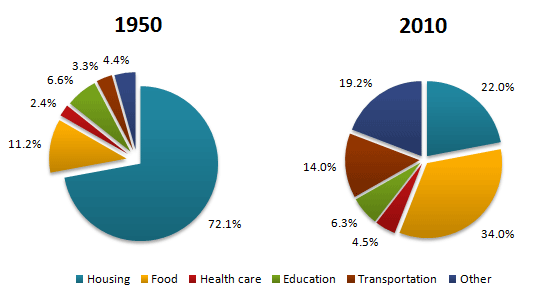
The pie charts below show the average household expenditures in a country in 1950 and 2010

The pie charts below show the average household expenditures in a country in 1950 and 2010IELTS Writing Task 1

The por chart tell us the facts that household expenditures has changed a lot from 1950 to 2010.
Housing is the biggest porportion being spent in 1950, with more than 70% of the spending has been done in this part, followed by food (11.2%), and education (6.6%). In 2010, food has become the area compose the most of the familial expenses. Housing becomes the second largest porportion whilst other miscilaneous thing becomes the third largest. Notably, the transport expenses has rised dramatically in these years, judging from that it changes from the second least porotion of the expenditure in 1950 to the third largest in 2010. While almost every part of the expenditure alters a lot during this period, the ratio of edcaiton expenses in the household expenses, on the other hand, remains stable. The health care plays 4.5% of the household expenses in 2010 and was only 2.4% of that 60 years ago.

Overall, housing was the dominant part of the expenditure in 1950 and people seem to tend to spend more evenly in 2010 for the differnece among every type of the expenditure is not so obvious as it wsa.

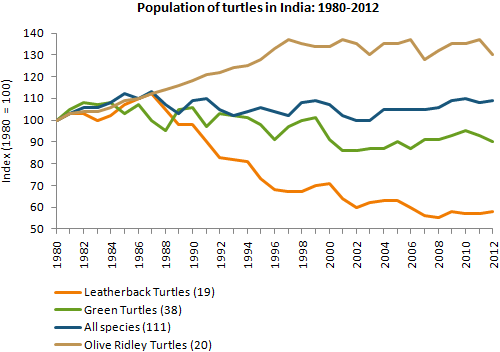
The graph below shows the population figures of different types of turtles in India between 1980 and 2012

The graph below shows the population figures of different types of turtles in India between 1980 and 2012.

IELTS Writing Task 1

The number of various types of turtles in India has been changing during these decades. Before 1984, the numbers of every species of turtles dont have big differnence. In late 80s, olive ridley turtles population starts to grow steadily and has been the biggest porportion of turtle popultion in India since 1988, whilst leatherback turtles also have similar trends between 1984 to 1987, it has falling rapidly since the same year and becomes the least since 1990. Green turtles are in the volatile status where its population differ from year to year with large number disparity with swings vigorious between 1990 to 2001, inspite of short icrease in late 1980s, generally it has drops by 10 index during this period. The overall observation of the turtles in India is, though  flucutating form time to time, waving in a small range of percnetage and slightly higher in 2012 than that in 1980.


writing practice

the diagram shows how frequent is differnet kind of usage of transportation in Edmonton and decipher the reasons for people using the cars.

People using the car dominates the patronage of every kind, with 45% of people are the drivers,  followed by people taking LRT (35%), bus and taxi. The porportion of people taking bus and taxi is identical, both composing 15% of the passengers..

Taking a closer look at the people using cars, we can understand that most people choose this way to communte to work, compose 55% of the population using cars. Several other reasons include business, taking children to school, with shopping and leisure activities pertaining to be the least porportion of the drivers population. 

Overall, though people driving cars for various reasons, they all choose this way as a major transportation to get around.

Wednesday, September 10, 2014

Now people in many countries can live and work anywhere they choose with improved communication technology and transport. Advantages outweigh disadvantages?

good
1. right to choose
2. incentives
3. getaway or castaway?
4. use the time efficiently (no commute)
Bad
1. low-income country (quality, danger, safety)
2. away from the family (long distance, drift away, faded, estranged)

Along with economic globalization, job searching also expands from domestic position to oversees vacancy or from a capital headquaters to another major branch. Variety of reasons can prompts a person want to find a job abroad, though sometimes it's just from the corporation's reassignment as the oversee branches needed.

People argues that being dispatched to another country causes family indisposition, estranged children, and aloof couple relationship. Besides, under the world spectrum where international business set up the branch in foreign states for lower wages expenses, most opportunities abroad is opened in low-income countries, some of which might not be the safe places to live. Crime rate and living condition could be onerous there, causing a lot of capable elites having doubts about working abroad, even nicknamed it as castaway with getaway. Technology helps to realize the long-distance conferences, but sometimes communication errors or misunderstanding is nor rare, casting people doubts about whether to live in a place and work in another.

However, working in the totally different places is definitely a huge perks on the resume. Carried with influenced cultural mime, especially foreign one,  it better our lot on the job searching in the global market. The family problem could be easily solved by high-end internet communication nowadays; talking your wife or husbands thousands miles away is never a question. Many countries also have special education facilities for children of the foreign workers, making it possible to move a whole family abroad or to another city. The employing company mostly give extra fringe benefit for those deployed. It should be a luring chunk of award for those striving for careers for years. Being reassigned abroad also prove one as highly competent agent who is probably multilingual and socially fluent enough to deal with  more volatile markets in foreign country. Job opening oversees available to choose often increase the worker's initiatives at home office, since fighting for a promotion becomes a shared momentum among colleagues.

All in all, under this highly cooperated economy whose business involves not only one sate or one company. It is important to make ourselves adaptive, highly mobile, and rapidly fit in. Otherwise, we'll all be ousted in this strong inundation of mainstream business model.
Tuesday, September 9, 2014

With major cities continue growing, are there any problems to young people? How to solve these problems?


With the technology keep advancing, people is getting more chances to live prosperously and of better life quality. Big cities are the byproducts of this process that brings bliss and blames. Since big cities has more job opportunities, they are always the first places where freshman flooding in for jobs and strive for career. Behind the glamorous glass-veiled skyscrapers and good-looking tuxedo, the beauty of the modern cosmopolitan does has some dark side that often been neglected. 

Cities has intense business activities and talented prodigy gathered around. Young people have to fight harder to get a job position in this contested atmosphere. Contorted interaction between human shows up under this situation. We might find people social mingles eloquently without having the real friend in need, since most of the parties in this contest have tacit purpose of building up network connection instead of having good time. Utilization of the substances extends to social networks. It is surely weird and ironical to find yourself in the middle of the crowd but still lonely and psychologically not pleasant as well. The life in a haste and bustle, huge pressure from work, and the environmental pollution imposes adverse effect on young physiques. Moreover, they have less time to invest their own interest and hobbies to establish a intact personality and balance out the exhaustion. The financial burden living in the cities is another problem going vile and rife nowadays. Rented room coined "Ant House" are not rare as it is only big enough to encompass one adult's bed and only places affordable for freshmen. The struggle is unfathomable for most of these people but they still endure, holding onto the hope that seemingly diminishes along with the hiking house price and inflation in urban area. 

Upon all of abovementioned problems, it is unclear whether the fiasco is getting better or not. We must implemented policies to help those hardly make ends meet and set up a more rookie-friendly working regulation to protect the labors. Also, government should consider a more transparent cash flow process to battle the corruption and embezzlement, which hurts the younger generation's future for centuries. Shifting the official power to new political candidates or entity could change the situation profoundly as well. The most important is that youngsters should learn to voice out their needs to grip the slippery opportunity and not afraid of being blunter about social welfare or public support that they deserved. After all, the best way to predict the future is to create it on our own.